
IKIGAI: The Japanese Secret to a Long and Happy Life is an incredibly popular concept with life coaches, Youtube advisers, and TED talks. It revolves around finding your life’s purpose, meaning, or “reason for being”. This Venn diagram has become the western representation of the ideology which is not the most accurate from the original, according to Sakulacostar who had spent many of her years on the Okinawa islands where this ideology was adapted from, and who is half Japanese.
That said, it is good to take every concept with room to research more and to form your own opinion. In my opinion, I think the Venn Diagram by Andrés Zuzunaga (pictured below) is effective in showing an overview of the aspects of IKIGAI, but it is presented in a way which makes one feel that there is a singular, deeply ‘meaningful’, mystical IKIGAI one should find in order to feel fulfilled when that is not necessary. Ikigai, according to some commenters on the IG reel linked above, can be simple or multifaceted too.
In any case, let’s get back on the topic of climbing out of an art crisis:
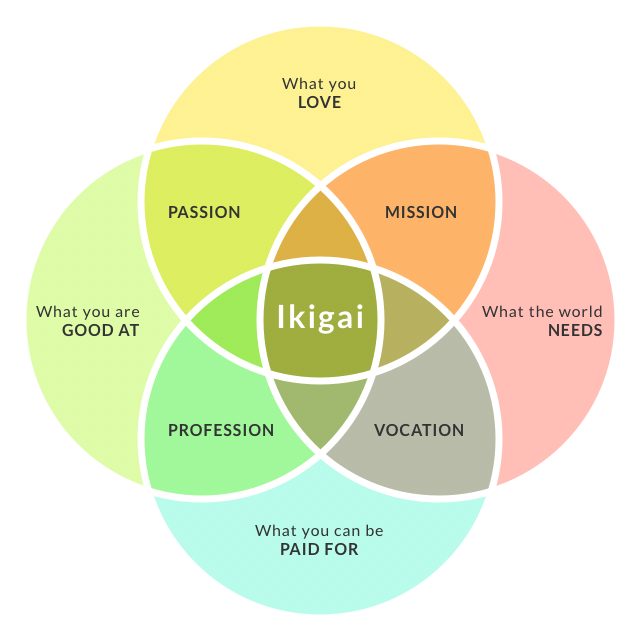
How I initially used this concept as a framework to finding my art style didn’t consider too deeply the quadrants of “What the world NEEDS” and “What you can be PAID FOR” because I believe that good art inherently has people who are willing to pay for it, and that the world in its current state needs MORE human made art as is. (For more on this, check out “The case for making art when the world is on fire” by Amie McNee | TEDxManchester) So just by doing art, we are contributing something to the world. And once my art is considerably ‘good’ , I can get paid for it. Therefore, my main focuses to figure out were:
– What I love (Aesthetically)
– What I am Good at (In relation to art)
What I love
As mentioned in part 1, like many people, I love love LOVE the beauty of the semi realistic style of many artists with intricate lighting, delicate linework and details. However, these was too far from what I was good at, so I reflected on what other styles I love. Some new patterns emerged from the artists, toys and styles that I love. Here’s a brief overview of my visual library:
Pictured: The Azura Series by Popmart Artist two.clouds, the Koeda chan series by Takara Tomy, The art of moving paper doll (PEPAKO) artist WASU (www.cermrnl.coml), the Art of Kae Tanaka, the art of Renz, the art of beffkawa, the art of my chibi (and upcoming gamer) model by baijiu, the art of omufumiko, and the art of nibo_ume_katsu, who I’ve commissioned a few times to create artwork for my standees!
I like these styles for different reasons, so I considered elements that I enjoyed from these inspirations to adapt into my own work. I noticed a pattern of liking big expressive eyes with a tiny nose, face and mouth, and exaggerated limbs like big hands and feet in proportion to the character. Bright, often almost pastel colour palettes, and decorations. I think those elements make these works look cute, so I wanted to adapt them into my own.
What I am good at:
I tried to keep in mind my own mastery level and whether a style like so-and-so’s is achievable for me or not. I believe that everything is possible with enough grit, but I grow most comfortably on the slope of enlightenment (on the Dunning Kruger effect mentioned in part 1).
I am good at making things cute, whether it is my intention or not. Through the Hime’s Design House series in 2024, (especially in the ‘Horror’ themed episode) I noticed had a tendency to make everything cutesy. The same tendency surfaced when I was trying to do Monster Hunter Wilds fanart earlier this year. It was a fun stream where I boasted being able to make any monster cute, so my community gave me many suggestions, and I think I was successful!
I am confident at making things adorable. However, apart from that, I don’t know what else I am good at. More experimentation or seeking the opinion of others will be needed for me to identify my strengths.
With all this in mind, I felt confident to move on to the next step – Art style trials! Part 3 is now up!