
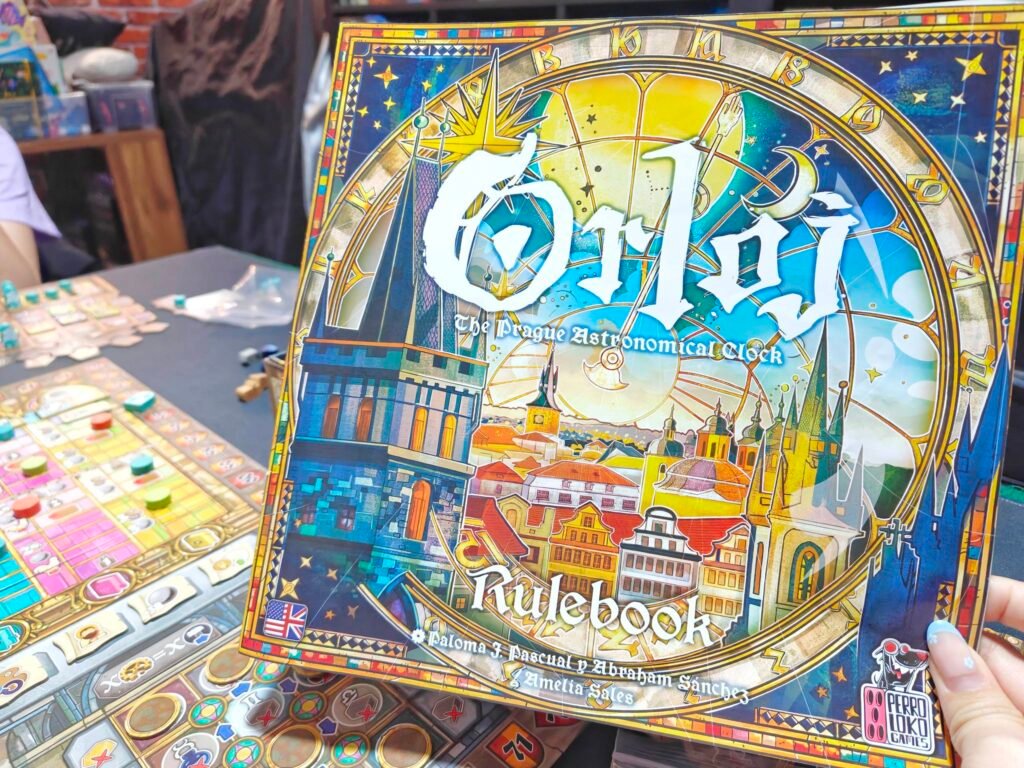
A while ago I had the chance to try Orloj: The Prague Astronomical Clock by Perro Loko Games, and what a stunning game it is! It is gorgeously designed, and the aesthetics was what drew me to it in the first place. The board is a work of art. However, due to the vibrant and saturated colours, some parts of the board were hard to distinguish and my eyes found need to take a break from staring after a while. The board is BUSY, but once you get used to it, it gets less overwhelming.
At first glance, the gameplay gives an intimidating aura, but with a little familiarisation to the board icons, you’ll be good to go. It is a comfortable eurogame that doesn’t doom you for possibly inefficient moves along the way, which makes it less stressful than titles like The Gallerist or Great Western Trail. (I appreciate all types, but after a long workday, those might’ve be too heavy for me…)
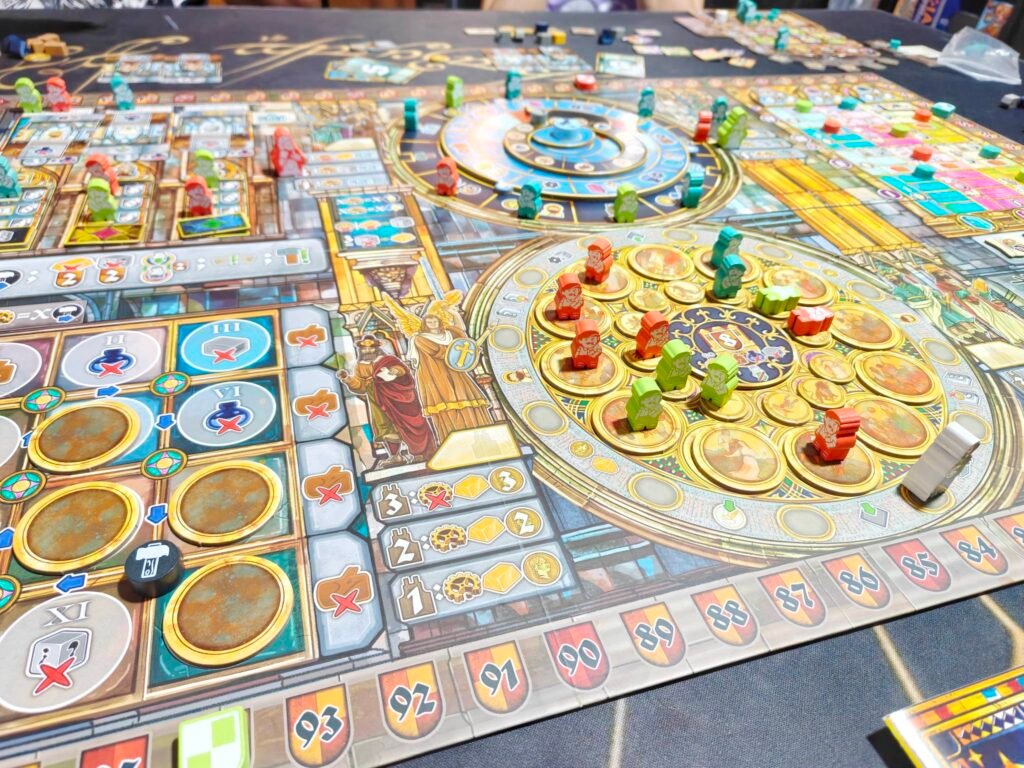
We played a 3-player game which lasted around 2 hours including learning to play, with our host having tried it at least once before. To be clear, this is a non-comprehensive review. And just an overview of what I recall of my experience with the game for the first time!
The game is set is Prague, where you and your team of assistants, artist, sculptor, and workers are tasked with constructing the Astronomical Clock. Each player is competing to build more of the clock than the others. At the beginning of the game, different parts of the clock are omitted, which adds a factor of randomisation to each playthrough.
Each turn, you turn the dial to do an action or pass to claim some workers. The game continues until one of the endgame triggers is met.

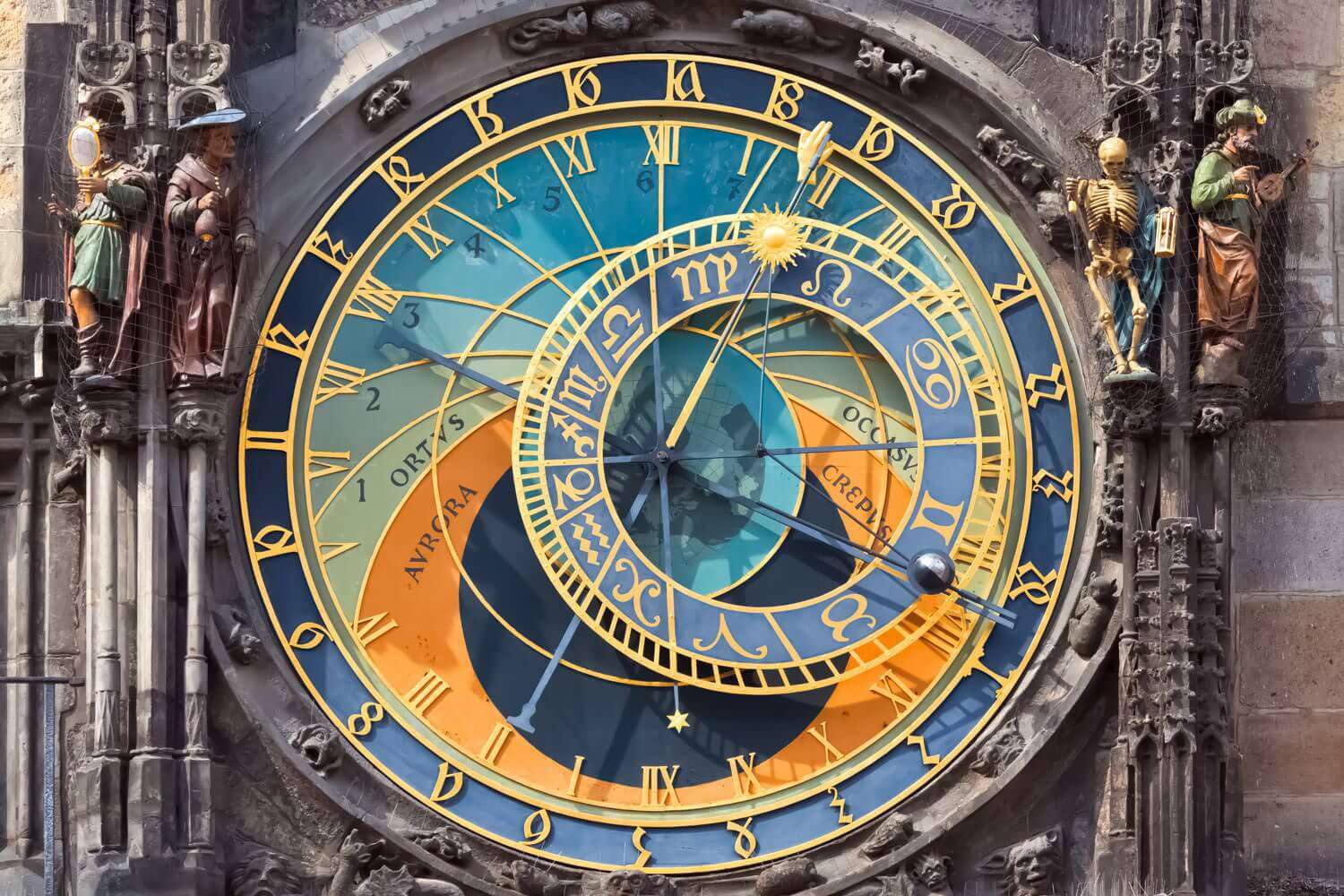
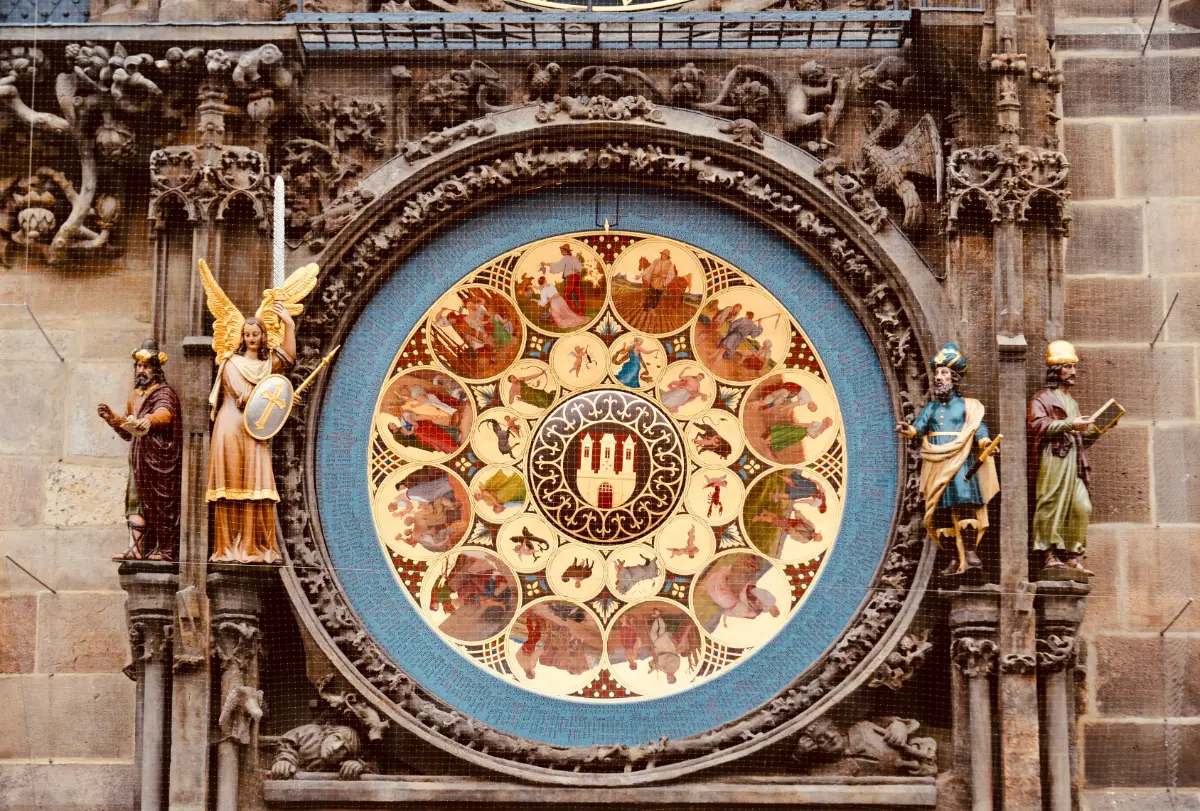
As you build the clock, you net points based on how many resources are expended to build with and if there are any adjacent parts already built by you, giving it an area control element. You also gain resources and actions from building the clock, according to what is on the artist’s face (outer grey ring). As the game progresses, the clock get more expensive to build, so don’t take the initial abundance of resources for granted!
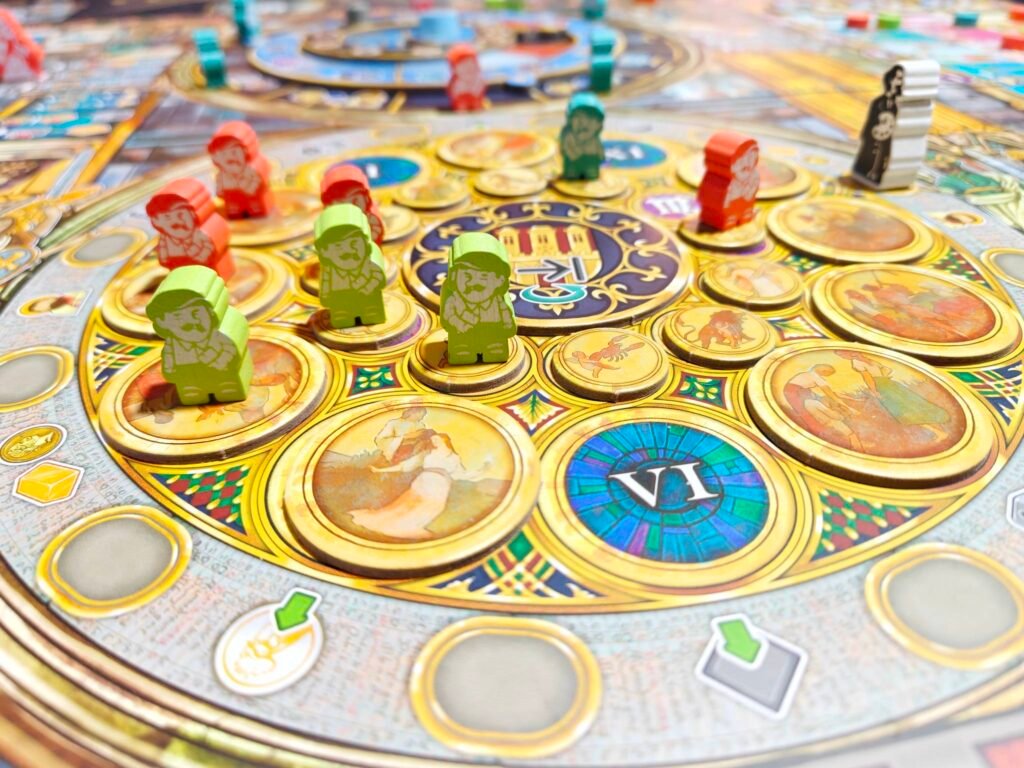
During your turn, whatever section of the rondal the clockhand lands on are the actions available for you to perform. You can crank gears to move the inner ring or clockhand to collect different materials and perform other actions, but beware, penalties await those who crank their gears beyond timely repair. There is no worker blocking too, so whoever is in the spot you want will just get their worker back for free.
All moveables (sculptor, artist, moon) give you access to other resources and actions, which expands the actions you are able to take outside of the clockface.
Actions include:
Recruiting apostles for the player board for bonus action/workers/resources and points if you complete rows or columns
Increasing your blue, pink or yellow track (for more movement, more efficient workers and recruiting assistants)
Increasing your resource track or build track (more resource yields, better build rewards)
Workshop: purchasing cards for extra resources/actions/workers and endgame scoring tiles
Moving the moon or artist (Collect resources, recover gear cranks)
Moving your sculptor (more powerful actions)
Building a clock piece (zodiac or month) – One work also has to be placed on the clock. Though it can be reclaimed, it is not worth giving up the area bonus for.
Other considerations are:
Availability of workers
Availability of apostles (out of 12, 2 will be available to recruit at a time)
Rooster token (intermittent scoring and recovering gear cranks)
If the shop cards can form a full picture (extra points, resources, etc.)
Track scoring and envelopes (first to the tip nets big bonus points! Envelopes give you bonus actions)
With so many nuances to the game, there is no lack of goals to work toward.
At the end of the game, whoever has the most points wins!
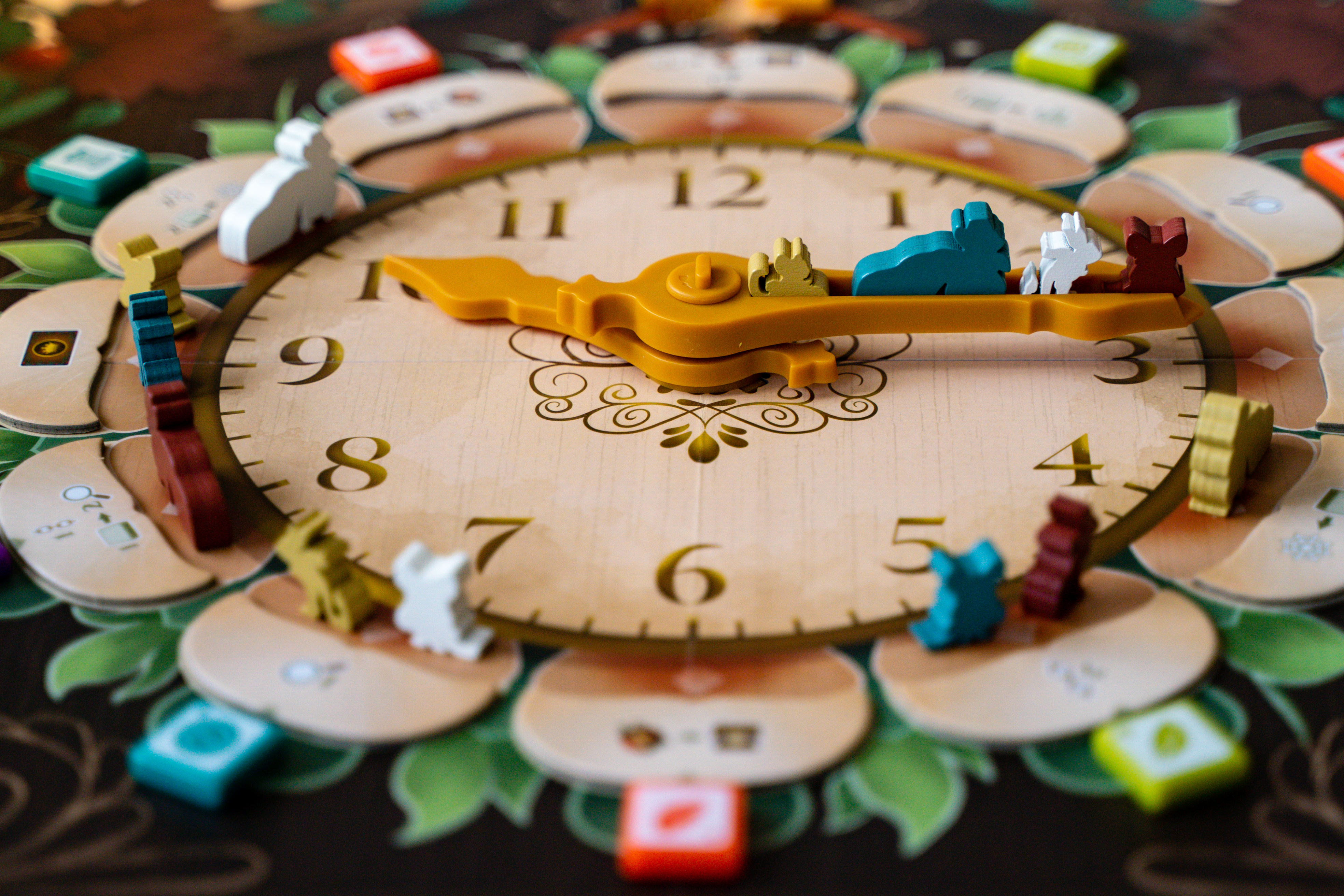
The clockface-action aspect of the game plays similarly to Hickory Dickory, which also features a clock face, but with 1 action instead of 2 using different sized mouse meeples. That game has a different method of ‘forcing’ players onto certain faces. It is quite fun, I’ll write a review on it if I get to play it again!
Overall, Orloj was a comfortable game with naturally moving parts. At no point did I feel too restricted or have a lack of options. The mechanisms in the game are well intertwined and the combination of actions felt satisfying to perform, especially after increasing your mastery track. If you are already familar with eurogamers, this will be a breeze to pick up. I enjoyed it, and would play it again!
There are lots of parts that can be moved, so it can feel complex. But the primary goal and way to score points is to construct the clock. A lot of the actions you take are to work towards that. It is nice that there are many ways to reach the same goals! I have not tried solo or 2 players, but I think 4 players will not feel too different from 3.
The player interaction came from the multiple ongoing races all across the board. From the mastery tracks, to the clock construction and bonuses. Every other players’ actions will likely require you to adjust your strategy along the way. So take it as a game that needs you to be a bit more flexible, but is also good at balancing it so that you have many options when you need to shift gears.
I hope if you get a chance to try, that you enjoy Orloj as much as I did!