
For our 10th developer interview, I had the great pleasure of interviewing the team behind Danchi Days! We tried the Danchi Days Demo as a part of our Steam Next Fest Demothon back in June and I had such a fun time interacting with the quirky characters in this game. In this interview, you will read about the great amount of love put into Danchi Days. I hope it encourages you to give it a try!
1. Thank you so much for taking the time to answer this interview! Could we get a quick introduction to you and gingham games?
Melos: gingham games is the development studio of mogumu, sandy powder and I. We have been working together since mid-2024. Lately, we’ve also had marketing assistance from friends Mei and Olivia. Danchi Days is mogumu and sandy’s first game, but I’ve been working on games for a long time at Analgesic Productions (Anodyne (2013), etc). mogumu is a Canada-based illustrator and sandy has a day job as a college lecturer.
mogumu handles the art, sandy does the original script (in Japanese), and I do music, code, JP to EN translation, as well as help lead the game design (which sandy helps out with).
2. Is the gingham games team working together remotely or in a studio? What does a typical day or week working on Danchi Days look like?
Melos: We work mostly remotely, although sandy and I are both in Japan. A typical week involves sandy and I figuring out what tasks mogumu, Olivia and Mei should work on, as well as working on the game’s writing, design, code, music, etc. We have rough milestones and long-term goals for the project.
3. How did the development of Danchi Days begin? What brought together the team?
Melos: The original idea came in Summer 2023 – sandy had an idea inspired by a favorite childhood game Uki-Uki Carnival (GBA). That game is about holding a town festival in a fantasy world, and sandy was interested in using a local Japanese danchi setting. That summer, we did some research into games, and a lot of brainstorming.
Over 2024, mogumu visited Japan. As we hung out, we had the idea to invite her on board for art after we had some things prototyped! Things started in earnest I’d say from June 2024. Since then we’ve been working on Danchi Days in bursts in between our other work. (For example, I’m also working on an action-adventure game, Angeline Era, this year).
We’ve all known each other for a long time before 2024, so it felt natural to form a team as we’ve been interested in games for a while. It so happened that we all had enough free time lined up to get the game past the initial hump of development.
4. Did any nostalgic personal experiences inspire the making of Danchi Days?
mogumu: For the art side of things, as a kid, I loved my GBA. I would be dragged out of the house a lot, so I played the GBA on car rides and in other people’s homes, like my grandparents’. Some of my favourite GBA games to play were Harvest Moon: Friends of Mineral Town (+HMMFOMT), Hamtaro Ham-ham Heartbreak, Ham-Hams Unite and Pokemon Sapphire. The pixel art, bright colours and cute art styles of people, animals, creatures, items and backgrounds were all things I really loved.
Another point of inspiration comes from my love of Neopets. It introduced me to the world of HTML and CSS, as you can create and customize each of your Neopet’s webpages, your user profile, shop and even guild! I fell in love with it quickly. You could add a lot of your interests and personality with graphics, GIFs, and MIDI music. I would spend hours visiting people’s webpages. It felt like a community before social media, and felt more like a personal hobby and craft. I loved seeing people’s anime shrines, collections of pixel pets, kao-anis and journal posts. I think back on those times a lot, and sometime during 2020, I found out about neocities and had a lot of fun exploring people’s websites again. I wanted to make my own but I didn’t get a chance to, being busy with work and family things.
Once I joined the team, I was really happy and excited to revive these nostalgic influences into Danchi Days!
sandy powder: When I was 11, the Japan-only GBA game Sakura Momoko no Ukiuki Carnival was released. I was immediately hooked! It’s an adventure game where you clear quests while inviting characters to a festival. I remember being immersed in the game as a little girl, feeling as if there was nothing more fun than the game. The very first inspirations for Danchi Days actually came from this experience – I wanted to make a game like it because no other indie games seem to have been inspired by Sakura Momoko no Ukiuki Carnival.
5. Danchi Days has a cast of quirky and loveable characters! I love that there are many ways to learn more about them, from interacting with them to their website pages. How do these characters come about, and do you have a character you are particularly fond of?
mogumu: When sketching and designing the characters, I try to make them funny, cute or loveable. Occasionally when I read the character descriptions, I am immediately reminded of people in my own life. A big one for me is Hoshino’s grandma. She reminds me a lot of my own grandma, both in health issues and personality. I gave her my grandma’s favourite colour, which is green, as well as her facial expressions, hairstyle, and fashion style. Another character, Chathie, reminds me of my mom. My mom, like Chathie, is a big chatterbox, has a lot of energy, is silly, and coughs sometimes LOL. I didn’t give her much of my mom’s physical features, but I did think of her when drawing her energetic poses, funny expressions, and general fashion. I think my favourite characters would be Grandma, Chathie, Hoshino, and Rio.
sandy powder: As the writer for Danchi Days, I come up with the original ideas for the characters. Many of the characters are not based on actual people but are based on what I’ve read or experienced. Many characters are intentionally written to be funny, and many of them have a fixation about the mundane things in life, so I hope our players can enjoy the lighthearted humor.
At the same time, each character is also a window into society’s larger issues, and I believe each can spark a deep conversation about wide-ranging topics, from dementia to the definition of what makes something fun, or even what comprises trust in a community – something that’s so essential to a functioning democracy. For players who are looking for something more than just laughs, I invite them to engage with each character like a philosophical discussion!
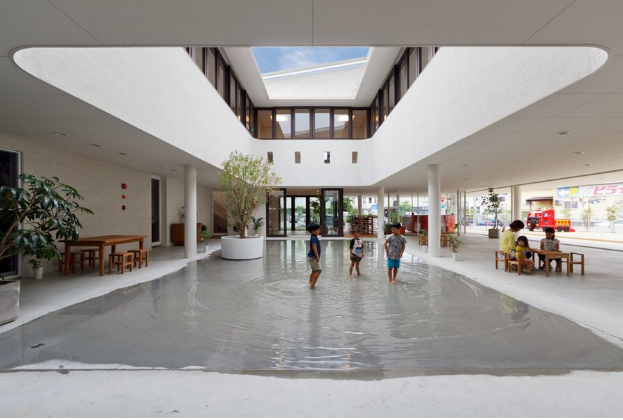
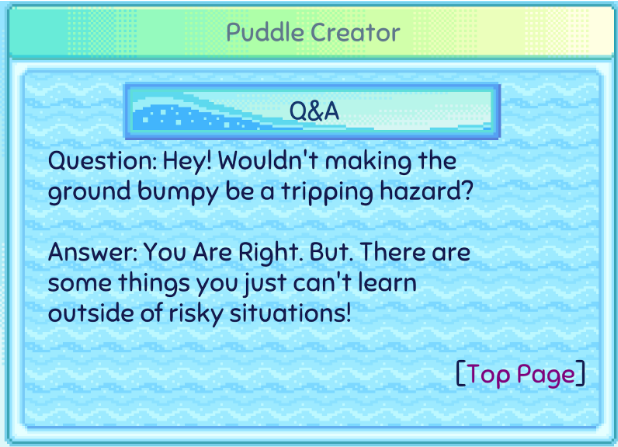
For example, Krysta is a puddle creator who loves making puddles. Her character is based on a daycare facility in Kumamoto, Japan, where the architect intentionally built a dent inside the daycare building and a roof that can be opened. You would think that the roof is meant to be closed on rainy days. However, in this daycare, they actually leave the roof open on rainy days, so the dent in the center of the building can collect water. The day after the rain, the children enjoy playing in the big puddle. I was so mind blown by how the daycare intentionally creates puddles so children can play in it. From this, I created Krysta – a person who doesn’t just play in puddles but also actively digs holes in the ground to create new puddles. Also, this daycare made me realize the relationship between having fun and being in a risky environment, so that’s what I tried to express on the Q&A page of Krysta’s website.
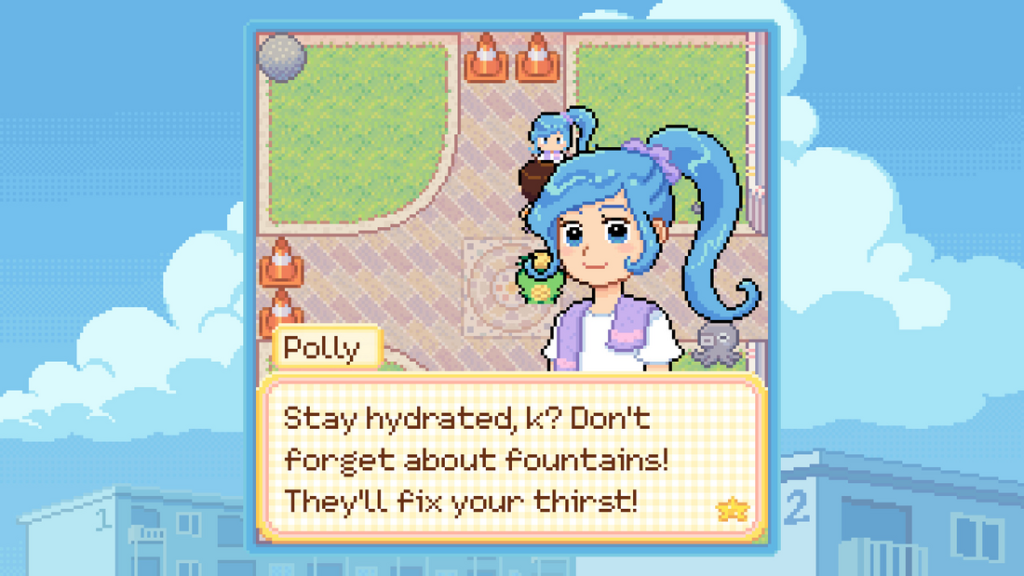
Another character based on things I’ve read or experienced is Polly. Polly loves to polish public water fountains. She is the crystallization of my personal love for public water fountains. I came to LOVE water fountains after moving to Tokyo in 2019, when I discovered my passion for walking. Tokyo is full of neighborhoods that are just a pure joy to walk in, but Japanese summers can be quite hot. So, you need to drink water often to stay hydrated. But, I don’t like carrying water bottles, because they can get heavy. But it turns out, even *without* water bottles, you can survive in Tokyo thanks to its many small public parks, often with a public water fountain! I always drink from them, but I’ve heard from many Japanese adults that they don’t drink from them because they feel that the water is dirty or they don’t want to share the same water fountains with other strangers. This made me very sad, because I think public water fountains, where anyone can drink free, clean water, are the core of a trusting community.
I have a theory. The less people trust each other in a community, the fewer public water fountains there are. What do you think? Polly invites you to ponder on your own water fountain habits and connect that to the topic of community trust.
6. The minigames are well balanced and fun! How did the team develop and test ideas for the many minigames in Danchi Days?
Melos: A big part of Danchi Days’ world is engaging with things that seem mundane or unremarkable and making connections with it to other aspects of life. I thought this was something that we shouldn’t just reduce to flavor text, but convey with a sense of physicality. However, I didn’t want to take a more traditional approach where you represent an idea with the most literal minigame translation (e.g. Cooking Mama cooking minigames), where you have to read and learn specific rules every time. Instead, where we landed after some prototyping was a common “Sense Game” language. Collect the sensations, move on a grid, bump into things. We then employed this language to create the various puzzly minigames. Even though each Sense Game introduces new mechanics, they never have to be explained, because people quickly learn the base language of the games. This lets players discover the solutions to each Sense Game on their own, and in that cycle of discovery and failure, a stronger impression is left on the players. (Compare this to having to read the instructions for every Mario Party minigame, etc.)
This more general design lets the Sense Games better embed themselves in the universe of Danchi Days.
It’s actually really easy to come up with minigames with this “language” in place. I usually have sandy test out the first version and see whether it is communicating well or not, and adjust from there. Certain decisions, like the Footsteps Bar, helps to give the game a bit of depth as we’re forced to design knowing there should be a ‘higher score’ you can aim for.
It’s designed to be pretty easy to beat the minigames initially, so long as you have just a bit of understanding of what’s going on. But for those interested in being “Sense Masters” you can try to really understand the game and figure out how to get a better score!
7. Are there any particular audiences you are hoping Danchi Days will capture the hearts of?
mogumu: I’m hoping people who like cute, nostalgic, weird things, and people who enjoy stories that are a mix of serious, heavy, sad, sweet, silly and fun will like our game!!
sandy powder: I hope that Danchi Days can reach people who grew up playing the GBA. Maybe it can help you recall some fun memories of playing video games when you were a kid! At the same time, having grown up into adults, I hope some of the heavier themes that Danchi Days deals with, such as dementia and clickbait, can touch your heart in ways that your favorite childhood games did not. Danchi Days is for those looking for a cozy game that is not afraid to tackle pressing issues that our contemporary society is facing.
8. As the first game published under gingham games, what were some challenges you had to overcome and what are your hopes for this first release?
Melos: It’s sandy and mogumu’s first game, so early on I was teaching some of the basics of prototyping/brainstorming/research… kind of like “coaching”, in a way? For them it’s their first time doing pixel art at scale (mogumu) or writing for a game (sandy). But as time has gone on they’ve both gotten up to speed and we’ve been learning a lot e.g. about game design and marketing together!
For challenges… nothing too out of the ordinary from a usual multi-year game, but I guess figuring out the marketing angle has been tricky with a game appearance that looks really ‘sunny’. The problem with marketing is it forces you to sell the game as an easy-to-understand “product”, but in actuality Danchi Days has many layers… so we’ve tried to make tweaks (to the marketing/store page) in ways to hopefully convey the game’s complex layers.
For me personally, it’s my first time doing significant localization (Japanese to English), so that’s been challenging but fun with making sure every character has a unique voice, and that reading in the game has a memorable rhythm and feeling to it!
9. What kind of gaming experience do you hope Danchi Days players will have?
Melos: I hope the game gets you to notice and be interested in the local world around you! If we can inspire anyone to try to get more involved in the world outside their door then we will be quite happy. On top of that, we hope players can enjoy the lighthearted humor and complex themes that sandy has mentioned, while enjoying the ride of the game’s main story!
10. Where can we subscribe to the progress and news about Danchi Days and future upcoming games?
Melos: Subscribe to our newsletter on Substack! Other than that, we’re on most social media. Bluesky and Twitter are our most active, but we also post updates to Steam, Youtube, Discord and Instagram (all links available at https://danchidays.com/ )
Big thanks to the team at gingham games for the wonderful insights into Danchi Days! If you are a game developer who is interested in doing a dev interview with us, drop me an email at himetokki@gmail.com! Thank you for enjoying this series thus far!
Pixel art for this interview’s banner by usa_lip