
ITTADAKIMASU CALEB GIRLIES because this week, Caleb’s 3rd myth dropped and it is DELICIOUS! My first impression of the myth was a sense of familiarity as someone who is Chinese and grew up in Singapore, where about 30% of our population identifies as Buddhist and 8.8% identify as Taoist. In this article, I will be sharing my observations about some of the Chinese-rooted motifs and theorize what the card’s story is going to be about.
I am super stoked to pull and experience this myth with you after it’s release! Saving my diamonds has been well worth it ;w; I will be announcing when we’ll stream it on my socials once it has been planned. Please look forward to it!
I’ve seen theories surrounding the myths floating around the internet but this myth in particular solidified for me that the 3rd myths, and perhaps the premise for the love interests themselves, could be based on the six realms of Chinese mythology (六道), derived from Buddhist cosmology. The further I dove into this theory, the more things began to align. But it was too much to write in this blog post, so I will be working on a separate essay addressing the similarities when I have the time!
I will link it here when it is available.
A few motifs mentioned make me inclined to believe this card to have been inspired by various religious and Chinese traditional beliefs. Some of the motifs I will address include the Hun (魂) and Po (魄) entities, the Naihe bridge, and the deity Zhong Kui (鍾馗) who I believe Caleb embodies in this myth. As a disclaimer, these are all my own observations and associations made through light research, I am open to hearing more about what your theories may be and correcting or clarifying things in this article if there is need to!
Hun (魂) and Po (魄)
There are various kinds of energies and spiritual powers in Chinese philosophy, but there are 2 main components of the soul which I believe MC and Caleb represent. Hun (魂), the cloud, ethereal soul, and Po (魄), the white, corporeal soul. Both exist in each living individual. The Hun soul (MC) is subtle and more spiritual compared to the dense, physical Po soul (Caleb). Hun and Po have energies and desires that exert themselves on an individual (us, player).
In Taoist belief, the aim is to cultivate and follow the Hun spiritual qualities to become lighter, refined and more spiritual while fulfilling the necessary Po desires for material and physical needs but also transcending it, as it has insatiable need. This is to help individuals reach a state of freedom from desire, ego, and attachment, which may be the direction that the myth story might go in. Along the way, we observe Caleb ‘feeding’ MC, fulfilling hunger “You’re hungry, again?” and physical need. (Y’know) He feeds her from the lotuses which are nourished by soulbeads, which in the trailer text is described to ‘replenish spiritual power and support cultivation‘.
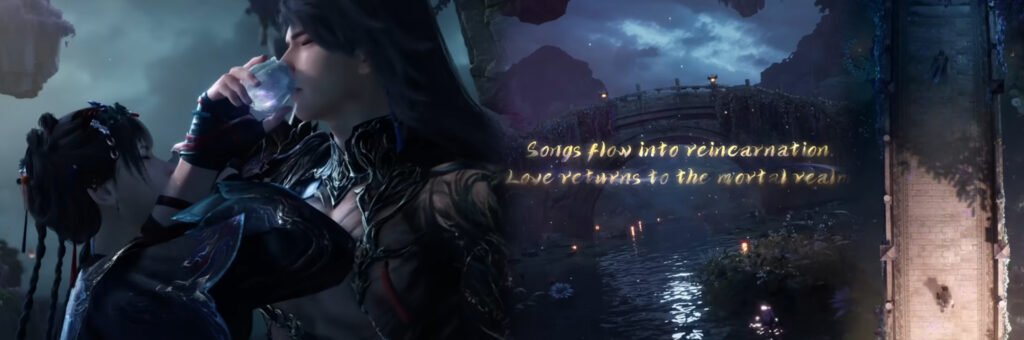
When an individual dies, the Hun and Po separate. Hun ascends to heaven while the Po descends to earth. This is probably what happens in the end, where they meet on the bridge only to separate. They can neither exist without one another nor exist together for long. Hence they always separate.
Naihe bridge (奈何桥)
In Chinese folk mythology, the Naihe Bridge is where spirits undergoing reincarnation have to pass. At the bridge’s side, Meng Po (孟婆), the Chinese goddess of forgetfulness, offers Five-Flavored Tea of Forgetfulness to deceased souls to allow them to forget their memories from past lives. There are a few more stops after the bridge, and after souls have passed through them, they enter the cycle of rebirth. The bridge has a yin and yang side. The west for women and the east for men. The imagery represents that “this life’s ties end, to meet again in the next”. Many of the visuals from the trailer clue us in that this is very likely the Naihe bridge:
Zhong Kui, King of Ghosts (鍾馗)
Lastly, we have Zhong Kui (鍾馗), the Taoist deity who is the vanquisher of ghosts and evil beings. The Zhong Kui narrative has taken many forms in Chinese mythology, so it is hard to pinpoint an exact storyline which the myth may follow, but his character is certainly an embodiment of the vanquisher of ghosts. He is seen in the beginning of the trailer doing exactly that.
Weapon-wise, depictions of Zhong Kui often hold a sword, but he also owns a bell. In the trailer, we see that Caleb uses a demon-subduing bell (降魔铃) to aggravate and destroy the ghost, delivering the final blow with a sword. In one interesting spin on the legend, when Zhong Kui returned to earth as a powerful ghost-slaying deity, he showed his gratitude for his loyal hometown friend, Du Ping (杜平) by arranging his sister to be married to him. (Hmm…)
Conclusion
Although the tone of the card seems to be tragic (again), if the myths are truly inspired by reincarnation, we can hope that Caleb and MC have gained enough karma over their following lives to have eventually met in modern day Linkon. Where perhaps, a happy end finally awaits them.
References:
jcoleman. (2026). Religious Diversity Around the World. Pew Research Center. https://doi.org/10.58094/ef8g-cr20
Reninger, E. (2019, May 13). What Are the Hun & Po in Taoism or Chinese Medicine? Learn Religions. https://www.learnreligions.com/hun-and-po-in-taoism-and-chinese-medicine-3182553
Twicken, D. (2026). Taoist Models of Hun and Po, Part Two | Acupuncture Today. Acupuncturetoday.com. https://acupuncturetoday.com/article/28537-taoist-models-of-hun-and-po-part-two
Naihe Bridge. (2025). BaiduWiki. https://baike.baidu.com/en/item/Naihe%20Bridge/16739
Zhong Kui. (2024). Linyuepingart.com. http://linyuepingart.com/en/zhongkui.php?id=28
Zhong Kui – Mythopedia. (2022). Mythopedia. https://mythopedia.com/topics/zhong-kui/