
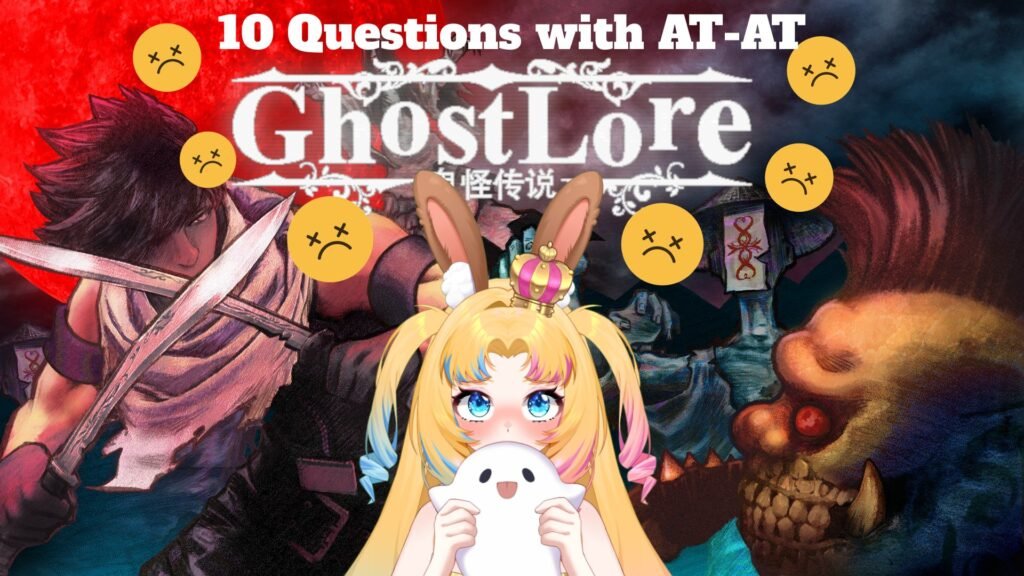
Over the Hungry Ghost Games Festival organised by SEAGamethetic last year, one game that caught my attention was Ghostlore, developed in Singapore! Andrew has kindly accepted an interview with us to tell us more about the inspiration and motivation behind Ghostlore. Thank you for being our 22nd dev interview!
1. Thank you so much for taking the time to answer this interview! Could we get an introduction to you and what you do at AT-AT Games?
AT-AT games is nominally an indie games company in Singapore. We’re just two individuals, really—I am Andrew Teo, the artist. My working partner is Adam Teo, the programmer. The similarity between our names is purely coincidental. We are not brothers, or related in any other capacity.
2. What is AT-AT Games’ founding story?
It’s a long story, but things really only blew up during COVID when I made this post on Reddit.
It was during the height of COVID where everyone was stuck at home, and I decided to share what I was doing during this time, which was making Ghostlore, an action RPG that features Singapore culture. The post blew up and the response to it was overwhelmingly positive. From there, Adam reached out to me via DM to offer a collaboration and the rest was history.
3. What games do you have fond memories of that you think may have had an influence on the making of Ghostlore? (In the Steam description, it mentions Diablo 2 and Titan Quest!)
In my childhood in the late 90s and early 00s, I played many many games on my family PC and secondhand PS1, and then later PS2 which I saved up money to buy. Diablo is just the easiest one to point out because it is of the same genre. But really… Ghostlore is a love letter to that entire era of gaming.
It makes me really really happy when people who lived through the same era tell me that they could feel the influence of Square-Enix games like Final Fantasy X, Kingdom Hearts and Chrono Cross. These influences are not so obvious because it is hidden in things like the aesthetics, the UI, the sound effects…
Since for me it is something that is so internalized it is difficult to point out specifically. But here is one example in worldbuilding: Although Ghostlore is set in a fantasy world, instead of a rustic style fantasy world with villages, animal transport, kingdoms and royalty, it is a more industrial and urban setting, with technological development being around par with that of our real world 1990s.
This decision was influenced by Final Fantasy VII, which takes place in a similar type of fantasy world with modern and urbanised elements. Back when I was a young boy, my understanding of ‘a fantasy story’ was something like, oh there had to be a knight, a princess, a castle and a dragon…the Final Fantasy series blew my mind. It made me realize that fantasy is whatever you want it to be and the only limit is your imagination.
I just feel really sentimental about those games and I think whenever someone can actually pick out these less obvious influences, really it feels more valuable to me than simply knowing how many copies Ghostlore has sold.
4. Are there unique challenges that come with being a Singapore-based indie game developer?
In Asia, Singapore does not enjoy the same level of cultural power that Japan, Korea or China has. Any big game that comes out of these other countries that have a reputation for good games almost has an assurance of quality among the core gamer audience.
I also hear that countries like Canada, Norway, and New Zealand also invest more heavily in their local indie games scene with things like grants.
But it is difficult for me to say what is ‘unique’ since I have only ever been a Singapore-based indie game developer. As opposed to being, say, an American, Canadian, Brazilian, Lithuanian, Malaysian, Korean or Japanese-based indie game developer. I think indie game development is challenging no matter which part of the world you are from.
5. What is your personal favourite class to play in Ghostlore and why?
All the classes in Ghostlore are intended to fill the archetypes found in ARPGs like Diablo. You have the melee skirmisher, the mage, the minion master, among others. But conceptually I like the Feral and Exorcist classes the most. Feral did not actually exist until someone online told me to look up the myths of weretigers in Singapore and Malaysia. Exorcist I like because even though it is really just a take on the minion controller type class found in other ARPGs, it has a very unique Asian supernatural flavour with paper talismans and skills that allow you to sense spirits.
I really wish that we leaned more into things like martial arts and qi. The Adept class was supposed to be that but I don’t know if it was communicated properly through the skill and class design.
6. In polishing a game like Ghostlore, what part(s) is/are the most time-consuming or challenging?
I find the most mentally draining and tedious tasks are the ones that don’t have much to do with directly shaping the game’s concept. Namely, localisation, controller support, and making sure our paperwork is in order, to pass the approval processes of the various distribution channels we have to deal with, such as Steam and Microsoft.
7. What keeps you inspired to continue game development?
Our audience. I want to create games for people who share similar tastes as me.
8. What kind of unique gaming experience do you hope players of Ghostlore will have?
Ghostlore takes place in a world that resembles Singapore in the 90s, because I am Singaporean and that is where I grew up. But on a larger level it is also an expression of what I think a good game is, as well as an expression of what I personally think is cool. I guess my sensibilities are kind of stuck in the 90s really.
9. What advice would you give to newcomers to the action RPG genre to progress more efficiently through Ghostlore?
Check out guides written by players in our community.
10. Where can we subscribe to the progress and news about Ghostlore and other upcoming games?
Online, Adam and I have a Discord server set up for Ghostlore and upcoming games.
Adam and I are working together on a new project, Ruin and Rebirth
Meanwhile, I have my own personal side project: ShadowRush. I’d be happy to talk about these games in future, if you’d allow.
Also feel free to look at my personal reddit profile. I talk about my games there from time to time, as well as other things I enjoy. I think it is the best way to get to know me as a person.
Offline, if you are in Singapore, I take part in SGGA Drinkup, a social event held on the second Thursday of each month, organized by the Singapore Games Association (SGGA). You can join their Discord to get reminded of the next one.
I also take part in public playtest sessions organised by members of the SGGA to get public feedback on my work-in-progress games. The SGGA Discord should have info on those as well.
—
Thank you so much for reading our 22nd developer interview, and my sincerest apologies for the delay in getting some of these up. Our site went through a major migration but we’re now back up and running! Hopefully, this means more consistent updates and features. Thank you so much again to Andrew for the interview and to AT-AT games for creating this incredibly replayable and addictive action RPG!
Hime’s 30-minute preview: