
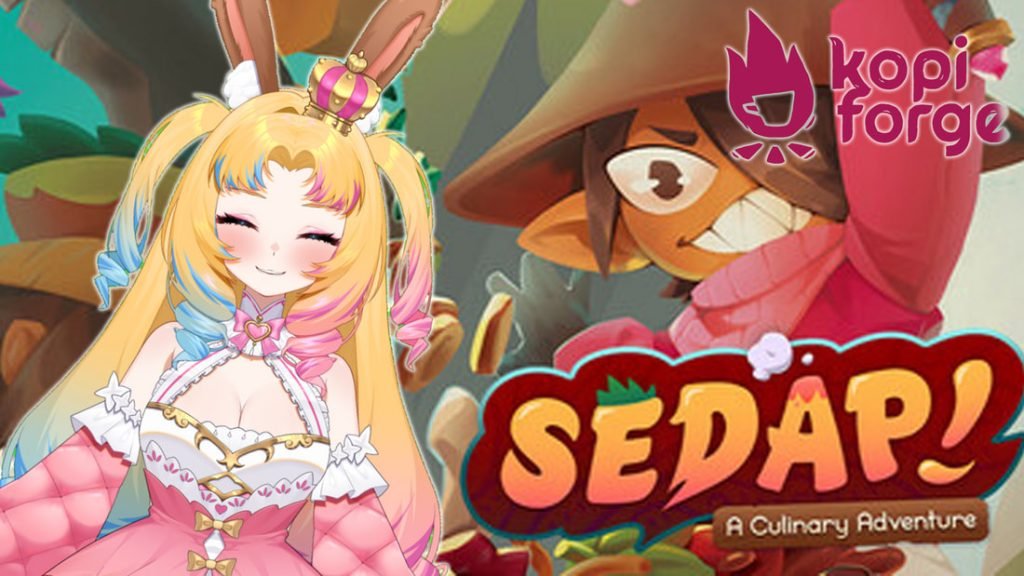
For our 7th dev interview, we have SEDAP! A Culinary Adventure, coming from our sunny shores! With the full release boasting an impressive 42-level campaign and endless co-op fun! Toi and Jay from kopiforge took a great effort to answer to these interview questions with valuable elaboration, so please enjoy the interview and don’t forget to check out the game and their socials (Links in the end)!
1. Thank you so much for taking the time to answer this interview! Could we get aquick introduction to you?
Toi: Hi there, I’m Toi, the Art Lead of kopiforge and SEDAP!
Jay: And I’m Jay, the Producer! I’m also part of the art team as a 3D artist.
2. What is kopiforge’s founding story? / How did the team come together?
Jay: kopiforge was found by myself, Toi and JT in December 2023, to develop our first game, SEDAP! A Culinary Adventure. SEDAP! was originally a final year project by myself and Toi when we were still in NTU ADM (Nanyang Technological University’s School of Art, Design and Media). Both of us were trained in art, not programming. So JT voluntarily hopped on to help out later on in the project. In the months after Toi and I graduated, we couldn’t find any full-time jobs in the industry. All three of us shared the common goal of continuing work on SEDAP! to make it a commercial game, so we formed kopiforge.
3. What does cultivating an open and inclusive studio environment mean to kopiforge?
Toi: We are a small team built on trust, respect and understanding—as such, we try to foster an environment where our team members can openly speak up about their concerns or their grievances, and discuss them collectively. Additionally, our hiring decisions are based solely on a candidate’s skill set and how well they fit with the team!
4. What are some of the team’s favourite games? And did any of them have a strong influence on SEDAP!?
Toi: My favourite game series growing up was Monster Hunter, so getting to design mobs for players to hunt for parts was very fulfilling for me! The Yamgolin mob in particular was heavily inspired by the tail-cutting mechanic of the franchise. I also often cite Ape Escape as an inspiration, since that game’s sheer silliness was my base understanding of how to make a game fun and quirky whilst being somewhat illogical at times.
Jay: I’m a super visual person, so I really enjoy games with stylised graphics. My favourite game is Ōkami, because it scores high on art style, music, storytelling and gameplay. I had a hand in designing some of our monsters and I would say the influence from another of my favourite games, MapleStory, came in there as well.
Ultimately, SEDAP!’s inspiration draws mostly from Overcooked!. It’s not my favourite game per se but I saw how it blurred the line between “gamers” and “non-gamers” when it went viral, because everyone was enjoying it. I think I wanted SEDAP! to have a similar effect–for it to be easily enjoyed by people regardless of their gaming experience, and in addition, have them learn about the vibrant cultures and cuisines of Southeast Asia.
5. What game engine is SEDAP! designed on and why?
Jay: SEDAP! was created with Unity3D. There’s not much of a deep reason besides personal preference – we spent more time working with Unity in school. I do think Unity handles stylised graphics better.
6. What fantasy and Southeast Asian elements can one find in SEDAP!?
Toi: The most obvious feature here would be the game’s many dishes—all of them were taken from real Southeast Asian dishes, like Thom Khem, Adobo and Fish Amok! As the artist, I tried to ensure the dishes still resembled their real world counterparts while giving them a more stylized, fantastical spin. Most of the game’s monsters are similarly inspired by Southeast Asian mythology, such as the Wakwak chickens, based on a vampiric bird from mythology of the Philippines. Some elements in the environment are also Southeast Asian in origin, like the giant trees you’ll find in the forest biome!
Jay: One thing I want to highlight is our soundtrack. Our talented local composers Rebecca Tan and Nicole Lee composed the game’s music with Southeast Asian instruments. Designing and ensuring that the experience was as immersive as possible was important to me–we not only want you to see Southeast Asia, but hear it as well.
7. What inspires the characters in SEDAP!?
Toi: Both protagonists’ outfits were designed to resemble traditional garments from various Southeast Asian countries. We tried to pick a nationality for each character, so we wouldn’t wind up with a scenario where they looked like too much of a mishmash of cultures. I drew inspiration for Som’s design from the colourful Baju Melayu my own relatives don every year, whereas Gon’s design was more heavily influenced by Vietnamese attire. As for their respective personalities, I wanted Som to embody the ‘culinary chaos’ we strove for when developing SEDAP!, hence his boisterous personality. Gon was intentionally made more subdued, just so you wouldn’t have two gremlins screaming in your ear all the time.
Jay: Besides Som and Gon, we have a small but fun supporting cast as well–Som’s older sister Merapi (derived from Mt. Merapi), the mysterious Dakila (whose name means “Great” in Tagalog!), as well as the three “Bosses” encountered on the island. I’m really happy with how Nagarasa came out, it was a tremendous effort for both myself and Toi from conceptualisation to 3D modelling to texturing. And of course, we have our beloved monsters as well. Each one of them is inspired by a Southeast Asian creature, whether mythological or not.
8. What benefits and/or challenges come with being an indie game dev studio in Singapore?
Toi: Video games are somewhat stigmatized in Singapore, with many amongst the older generation believing them to be harmful or a waste of time. It’s hard to be taken seriously a lot of the time, especially when seeking support or even when just sharing your job with a stranger.
Jay: I think we do have a really supportive indie gamedev community in Singapore and Southeast Asia. When we first started kopiforge, they gave us a very warm welcome and were eager to help. I would say that the biggest challenge that we face is the lack of government support when it comes to project funding. This troubles me because operating in Singapore comes with higher development costs due to the high cost of living. Publishers are often more inclined to fund larger teams in other countries where the same budget stretches further. Many of these countries offer strong government support and funding for locally-created media and game development, giving studios there an added advantage.
9. Now that SEDAP! has released, what responses have come in that were expected and unexpected?
Jay: Our release week was pretty chaotic (it’s still quite chaotic now). Majority of our players are from China, and we were bashed with harsh negative reviews from them mainly because of connectivity issues. Network performance there can be unstable, and players often need to rely on third-party software called “accelerators” to access and play our game smoothly. It was discouraging to see our review score on Steam drop from 90% positive to 60% positive within the same day. Before release, we did test our online connectivity with friends living across the world, and it was pretty stable, so we thought that it would be alright.
There were also two other issues, which was our game having lots of bugs, and late-game levels being frustrating and difficult. Admittedly, we didn’t catch many of these bugs during our QA sessions, mainly because we didn’t have much experience with QA and that we mostly relied on volunteer playtesting. We also didn’t pick up on late-game levels being extremely frustrating because we received feedback that the challenge was fun, and internally the team grew used to the levels. Anyway, we’ve pivoted to bug-squashing mode since then, and we’re also actively taking in player feedback and are planning to balance the late-game more.
On the flip side, aside from the negative Chinese reviews on Steam, reviews have been mostly positive. We have an average rating of 8.5/10 across different review sites, and people do tell us that they’re enjoying the game. I really appreciate it when people are understanding towards our mistakes, and take into context that we’ve mostly been a 3-man team with no prior commercial-game-releasing experience releasing our very first game. Despite the rocky release, I can safely say that we did our best with what we could, and I’m proud of our team for pulling through.
There’s definitely a lot of learning points for the team after SEDAP!, so I hope our players look forward to our future updates and future projects!
10. What can we look forward to in future updates to SEDAP!?
Jay: Squash more bugs, make more improvements = smoother gameplay experience! This does take time though, so I’d like to kindly ask everyone for their patience. We do have a few new features planned for the future, such as a new section in the Makanomicon dedicated to Khaya Island’s monsters. I think some players have been asking for that, and we’re also happy to share the official names and descriptions of the critters you’ve been fighting!
We’re active on our Discord and we always post on Steam (patch notes, announcements, etc.), so head over there to see the latest updates regarding SEDAP!
Lastly, we just announced SEDAP! for consoles (PS5, Switch, Xbox), coming to you in Q4 2025! I personally think SEDAP! is best enjoyed couch co-op style, so I’m really excited for this!
SEDAP! A Culinary Adventure is certainly a labour of love for the small team at kopiforge. Let’s give it our full support and have patience as the team addresses some bugs and adds new features! I’m excited to see what’s in store for SEDAP! I hope you are too! Follow them on their socials found on linktr.ee as well. Thank you for supporting this series thus far!
If you are a game developer and are interested in an interview with me, please do not hesitate to send an email inquiry to himetokki@gmail.com. I am always looking to spotlight more games through this series. Please look forward to our next one!